
Reading Time: 3 minutes
Now that Dreamforce 2025 has come and gone, it’s time for us to take a step back and dig into all the latest announcements. One of the biggest announcements in the media ecosystem would be the introduction of Data Cloud Clean Rooms. This has been something our clients have been looking forward to since the introduction of Agentforce for Media and Entertainment (formerly Media Cloud) and is a major step forward in the platform’s evolution.
What are Data Cloud Clean Rooms?
At its core, a Data Clean Room is a secure environment where two or more organizations can upload, harmonize and analyze audience data without ever directly sharing any personally identifiable information (PII).
With a Data Cloud Clean room connected to Agentforce for Media and Entertainment, publishers can:
- Upload their own first-party audience, subscription or other data and collaborate with advertisers, agencies, or even other publishers.
- Ensure that all of their data remains anonymized in a secure environment
- Build unique, shared audience segments that can be used during media planning and activation.
In a Data Cloud Clean Room, neither organization can see the other’s raw data. Instead, they work with encrypted identifiers that can be used to surface valuable insights but not individual identities.
Why Data Cloud Clean Rooms?
As the eventuality of the death of third-party cookies continues to loom over the industry, first-party data matters more now than ever. Whether you’re an established publisher or an emerging retail media network, your first-party data is the secret sauce of your ad sales organization, allowing you to develop unique and valuable audience segments to drive premium rates across your portfolio.
However, this is really just one piece of the puzzle. What about all of the insights you could gain from the data of your advertiser clients as well? Both publishers and advertisers benefit when they can leverage both organizations’ data to improve targeting.
Benefits of Data Cloud Clean Rooms
- Privacy-safe collaboration: Companies can work together on data analysis without compromising sensitive customer information.
- Enhanced insights: Organizations can gain a deeper understanding of customer behavior by combining their first-party data with partners’ data.
- Privacy compliance: The zero-copy architecture helps maintain compliance with data privacy regulations.
- Secure data activation: Matched results can be activated into campaigns without the risk of exposing raw data.
How do Data Cloud Clean Rooms work with Agentforce for Media and Entertainment?
First, as a publisher, you’ll upload your first-party audience data from subscriber lists, engagement behavior, site and app traffic, and CRM data. Your advertiser counterpart will then upload their customer data, such as loyalty program members, eCommerce, or POS data.
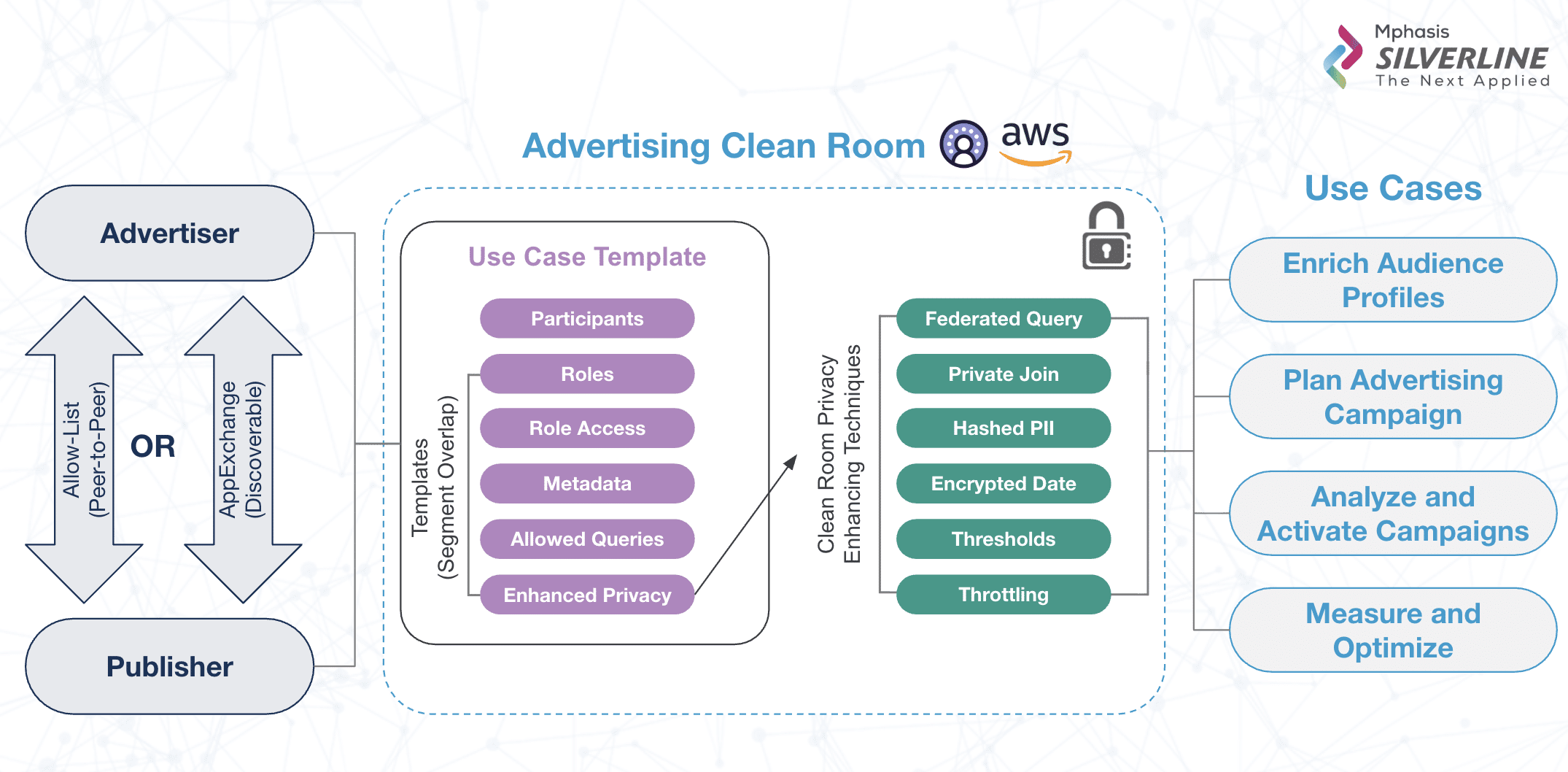
Both of these data sets then enter the Data Cloud Clean Room, where the individual identities of all individuals are anonymized and the data sets are matched securely. The result is a shared Audience Insight Layer that the organizations can then use to co-design custom audience segments that can be leveraged during the media planning process in Agentforce for Media and Entertainment and passed along to the relevant ad servers for activation.
This is a game changer, allowing publishers and advertisers to run analyses in AWS without their data or their users ever leaving the security of Salesforce Data 360 (formerly Data Cloud). Additionally, it makes Data Cloud Clean Rooms a foundational collaborative platform for secure data collaboration across the entire enterprise, from supply chain and R&D to financial services.
Data Cloud Clean Room is the first, broad connectivity platform to offer zero-copy integrations for all the major platforms: AWS, Google BigQuery, Databricks, Snowflake, and Azure. Built on the zero-copy architecture, this will enable businesses to collaborate on analytics, build predictive models, and activate campaigns while complying with privacy regulations. This is achieved through federated queries, where data is virtually pointed to rather than physically moved, and the results are aggregated insights rather than raw customer lists.
Private collaborations, such as co-marketing use cases, can be supported via the peer-to-peer connection using an Allow List configuration, and providers can make themselves discoverable and publishable via the AppExchange. Salesforce is establishing the new standard for how businesses will securely collaborate to grow and scale data sharing for campaigns and promotions between partners (i.e. publishers and advertisers).
When can you start?
Data Cloud Clean Room functionality is currently in active Beta Status. If you’re already a Data 360 customer, you can try activating this feature in a sandbox today. As always, we’d recommend reaching out to our team at Mphasis Silverline to assist with getting you started on this exciting path!
For additional information, please feel free to connect with John Stamers or Manish Sheth.